Showing posts with label English. Show all posts

May 9, 2014

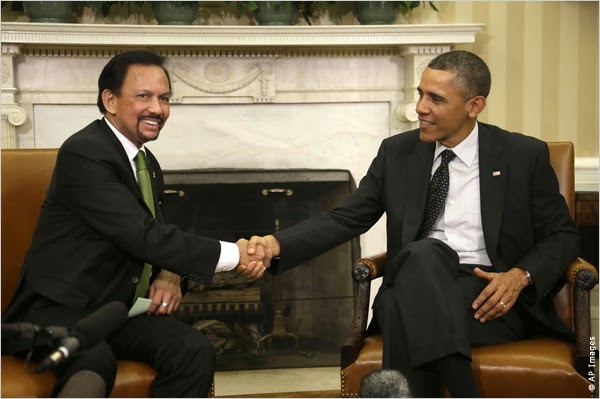
King of Brunei Betrays Islam


News:
Last week Hassanal Bolkiah, the Sultan of Brunei unveiled plans to implement sharia law. He said, "With faith and gratitude to Allah the Almighty, I declare that tomorrow, Thursday 1 May 2014, will see the enforcement of sharia law phase one, to be followed by the other phases."
The plan was immediately denounced by the West and recently famous western personalities have started boycott properties in the West owned by the absolute monarch.
Comment:
Media reports clarified that Sharia law would only be limited to penal matters and that it would be implemented in three stages. The first stage includes: fines or jail terms for offences ranging from indecent behaviour to failure to attend Friday prayers. The second stage will include: Islamic punishments for theft and robbery, while the last stage will cover Islamic punishments for homosexuality and adultery. The edict also stated that the law would be applied to both Muslims and non-Muslims.
There are three main problems with this announcement. First and foremost, is that Islamic sharia cannot be restricted to mere penal codes. Islam is a complete way of life and the Islamic sharia is responsible for governing all aspects of life, which are more than just criminal matters i.e. it also encompasses social, economic, political, foreign affairs etc. To compartmentalise or secularise Islam is strictly forbidden. Allah سبحانه وتعالى mentions in the Quran:
وَمَن لَّمْ يَحْكُم بِمَا أنزَلَ اللّهُ فَأُوْلَئِكَ هُمُ الظَّالِمُونَ
"Those who do not judge by what Allah has sent down, such people are Zalimoun (wrongdoers)."
(Al Maidah: 45)
وَمَن لَّمْ يَحْكُم بِمَا أَنزَلَ اللّهُ فَأُوْلَئِكَ هُمُ الْفَاسِقُونَ
"Those who do not judge by what Allah has sent down, such people are Fasiqoon (deviators)."
(Al Maidah: 47)
Incidentally, the Sultan of Brunei quoted these very same verses in the speech announcing the implementation of such punishments. Yet, he remained oblivious to the fact that these same verses also apply to rule by Islam in all aspects of life, and that includes the right of the Ummah to select their ruler and not someone who was imposed upon them by the British.
Second, Islam cannot be implemented in a piecemeal fashion, where the implementation of some rules is delayed. Picking and choosing between the implementation of Islamic rules is a grave sin. Allah سبحانه وتعالى says
أَفَتُؤْمِنُونَ بِبَعْضِ الْكِتَابِ وَتَكْفُرُونَ بِبَعْضٍ فَمَا جَزَاء مَن يَفْعَلُ ذَلِكَ مِنكُمْ إِلاَّ خِزْيٌ فِي الْحَيَاةِ الدُّنْيَا وَيَوْمَ الْقِيَامَةِ يُرَدُّونَ إِلَى أَشَدِّ الْعَذَابِ وَمَا اللّهُ بِغَافِلٍ عَمَّا تَعْمَلُونَ
"Do you, then, believe in one part of the Book and reject the other? What repayment will there be for any of you who do that except disgrace in this world? And on the Day of Rising, they will be returned to the harshest of punishments. Allah is not unaware of what you do."
(Al Baqara: 85)
Again, Hassanal Bolkiah quoted this verse, but did not choose to ponder on its meaning, as it fully applies on him.
Third, the secularisation of Islam and its gradual implementation will never bring dignity or honour to the Ummah, nor will it grant her peace and security. The only reason Hassanal Bolkiah and other rulers persist with the gradual implementation of Islam is because it allows them to mollify the sentiment of Muslims and maintain the status quo, which is to guard the riches of the Muslim lands for the Kafir colonialist powers.
Besides this, the piecemeal implementation of Islam will never yield the full realisation of Islamic sharia in Muslim lands as it is commonly understood by some. The Muslim Brotherhood in Egypt and the Taliban in Afghanistan have found this out to their own cost.
All of this gives relentless ammunition to the enemies of the Ummah to point fingers at Islam's inability to solve problems, which again is major exaggeration of reality. When the messenger of Allah صلى الله عليه وسلم established the first Islamic state in Madina nations embraced Islam, as they witnessed first-hand the complete implementation of Islam working in practice. This was followed by the Khulafah after him صلى الله عليه وسلم.
Hence, Muslims must redouble their efforts to re-establish the Khilafah Rashida, as the only means to fully realise the complete implementation of Islam, and also to silence the Kafir colonialist. For surely, when the Khilafah returns, the oppressed people in the West will leave in droves to embrace Islam causing their rulers immense distress and anguish.
Written for The Central Media Office of Hizb ut Tahrir by
Abu Hashem

Khilafah.com

Apr 14, 2013

Hizb ut Tahrir Organises a Critical Women's Seminar: "Hasten to Establish the Khilafah to Protect the Honourable Women of Al-Sham"


H. 04 Jumada II 1434
M. 2013/04/14
No:1434 AH/ 43
Press Release
Hizb ut Tahrir Organises a Critical Women's Seminar:
"Hasten to Establish the Khilafah to Protect the Honourable Women of Al-Sham"


Under the support of the eminent scholar of Usool, skilled politician and prominent thinker Ata Ibnu Khalil Abu Arrashtah, Amir of Hizb ut Tahrir, the Hizb will hold a vital women's seminar on the 27th of April 2013 in Amman, Jordan to speak of the heart-breaking plight that the women and children of Syria live and to present effective solutions to bring an urgent end to the massacres executed by the tyrants of Ash-Sham. This unique, unprecedented event, entitled "Hasten to Establish the Khilafah to Protect the Honourable Women of Al-Sham" is the first high-profile women's only gathering aimed at focussing world attention specifically on the horrendous scale of suffering and brutality endured by Syria's women and children at the hand of the mass-murderer Bashar Al-Assad and his Kufr Ba'athist regime. The seminar will host a large audience of journalists, distinguished influential women, representatives of organisations, and will also invite Syrian women from Jordan, including some from the Zaatari refugee camp to attend. It will also consist of 3 main talks, a video containing testimonies from Syrian women regarding the tribulations and ordeals they have suffered, a panel discussion with high-profile women from Hizb ut Tahrir, and a press-conference.
The opening speech will be from the Women's Section of the Central Media Office of Hizb ut Tahrir that will highlight the failure to date of the Muslim governments and international community to offer any credible solution to bring an end to the living-hell that the women of Syria have been subjected to under Assad. As well as their initiatives and missions have simply bought the Syrian regime time to pursue its campaign of terror and slaughter and violate the honour of the noble women of Al-Sham. The talk will emphasize that it is the Khilafah system alone, based purely upon Islam, it is the only system that views the life and dignity of women as priceless, places the protection of their blood and honour as a priority, and appreciates the heavy obligation of the state to guard their safety without hesitation or delay. The second talk will be delivered by a Muslim sister from Syria who will provide detailed, graphic eye-witness accounts of the abduction, torture, rape, and murder of women and children at the hands of the merciless Syrian regime as well as highlight the desperate situation in the Syrian refugee camps where women and children battle for survival, living in inhumane, appalling conditions. She will also emphasize how the women of Al-Sham have been abandoned by the heartless rulers of the Muslim world who have sat as idle spectators to the killing fields next door without mobilizing a single soldier in her defence. The final talk will be delivered by a female member of Hizb ut Tahrir Jordan who will raise a call to Muslims globally to increase their efforts to establish the Khilafah urgently as well as deliver a heartfelt appeal to the sons of the Muslim armies to fulfil their great Islamic responsibility of defending their sisters in Al-Sham without delay and to give the Nusrah (material support) to Hizb ut Tahrir for the establishment of this noble state that will bring the shade of guardianship to the region under the Rule of Allah (swt).
We call the media to attend this important and most pressing of seminars that will not only provide a platform for the heart-breaking stories, hopes and dreams of some of the most vulnerable victims of this brutal conflict to be heard but will present a sound vision to bring their suffering to an end. The event will be streamed through the live broadcast of The Central Media Office of Hizb ut Tahrir.


Dr. Nazreen Nawaz
Member of the Central Media Office
of Hizb ut Tahrir

Jan 21, 2013

Mali and the Treachery of the Rulers

Mali and the Treachery of the Rulers

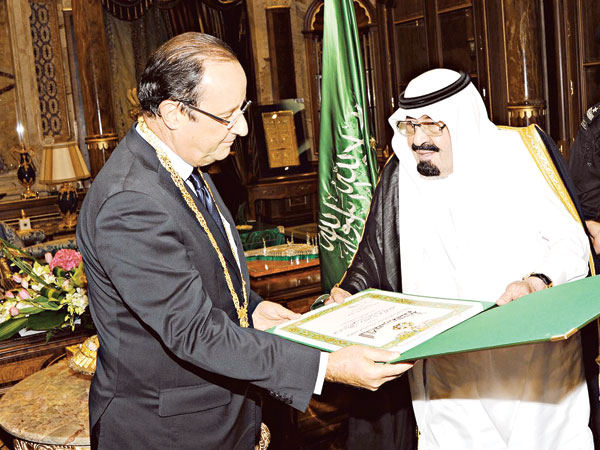
It is with great anger that the great Ummah of Muhammad صلى الله عليه وسلم are witnessing another war against Muslims and another military campaign in Muslim lands. From the very start of this new assault reports have been coming in of about the killing of civilians and children by the French war machine which includes air bombardment and ground invasion. The French President Francois Hollande has stated clearly whilst visiting the Gulf States that he will not permit the establishment of an Islamic State in Mali.
France's hatred towards Islam is well known and just recently Francois Hollande during his visit to Algeria made it clear that neither he or France would ever apologise for the slaughter of one million Algerians at the hands in the second half of the 20th century in addition to the thousands of rapes and horrendous acts of torture committed in the name of the Republic. Although this hatred is blatant the real reasons for this attack is for France to maintain its influence within Africa which is rich with vital natural resources and minerals and it fears not only the loss of its influence and interests in Mali but other African states that may follow.
Indeed this Ummah has been attacked by its enemies and continues to be attacked by its clear enemies in many Muslim lands and Mali is an addition to a long list including Chechnya, Kashmir, Palestine, Afghanistan, Yemen, Pakistan and the collaboration of all the western countries in regards to the continuation of the spilling of innocent blood in Syria is a matter that hides no ambiguity.
This war against our Ummah and lands is not unexpected and it is only natural that the colonial western powers will target us not only for our vast natural resources which they desire to be theirs but also because we represent the only foreseeable challenge to them in the future, which they see drawing nearer and nearer. However what is not natural and disgusts us the most is the support that our Muslim rulers have given to France and its allies to conduct this campaign. During Francois Hollande's visit to the Gulf States after the bombs has already began to fall in Mali, he stated that he is expecting the full support of the Gulf States. Not only was this red carpet laid out for this colonial murderer of Muslim children and invader of Muslim lands but help and support was offered to him by these traitorous rulers to the point where vast amounts of money has been pledged to support the French campaign. This in addition to the support given by the North African States and acquiescence of all others.
Allah سبحانه وتعالى says:
إِنَّمَا يَنْهَاكُمُ اللَّهُ عَنِ الَّذِينَ قَاتَلُوكُمْ فِي الدِّينِ وَأَخْرَجُوكُمْ مِنْ دِيَارِكُمْ وَظَاهَرُوا عَلَىٰ إِخْرَاجِكُمْ أَنْ تَوَلَّوْهُمْ ۚ وَمَنْ يَتَوَلَّهُمْ فَأُولَٰئِكَ هُمُ الظَّالِمُونَ
"Allah merely forbids you from taking as friends those who have fought you in the deen and driven you from your homes and who supported your expulsion. Any who take them as friends are wrongdoers."
(Al-Mumtahanah, 60:9)
يَا أَيُّهَا الَّذِينَ آمَنُوا لَا تَتَّخِذُوا الْيَهُودَ وَالنَّصَارَىٰ أَوْلِيَاءَ ۘ بَعْضُهُمْ أَوْلِيَاءُ بَعْضٍ ۚ وَمَنْ يَتَوَلَّهُمْ مِنْكُمْ فَإِنَّهُ مِنْهُمْ ۗ إِنَّ اللَّهَ لَا يَهْدِي الْقَوْمَ الظَّالِمِينَ
"Oh you who believe! Do not take the Jews and Christians as your friends; they are the friends of one another. Any of you who takes them as friends is one of them. Allah does not guide wrongdoing people."
(An-Nisaa, 5:51)
The betrayal and treachery of those who claim to rule us have no limits. Their loyalty is and has always been to their masters who made and established them after the destruction and removal of the Islamic State from existence in the international arena and the dissection of the Ummah into its many smaller parts, each with their own flags and national anthems.
It cannot be disputed that the loyalty of each and every one of these rulers is to the West and not to Allah Azza Wa Jalla and the believers. In this case, as made clear in the above Noble Aayah, Allah سبحانه وتعالى has declared that he is free of them and they are nothing to Him, so the question that follows is: Will we now free ourselves and clean our hands of them? And will we work to bring back the representation of the honour, might and power of this Ummah that the West broke and are working night and day along with their puppets in the Muslim world to prevent from coming back? Will we also work night and day to re-establish the Islamic State, the Khilafah upon the path of the Prophethood, leading to the resumption of the Islamic way of life in this Dunyaa? The Imaam who will stand in the way of the aggression, protect our lives, honour, wealth and sanctities?
The Messenger of Allah صلى الله عليه وسلم said:
"Verily only with the Imaam will you have a shield behind which we will fight and behind which we will be protected." (Saheeh Muslim)
Source
islamicsystem.blogspot.com

Jan 16, 2013

Hiding Naveed Butt's Abduction from the Public will not Hide it from Allah, Al-Baseer!


Hizb ut Tahrir condemns the Kayani-Zardari regime for locally blocking the website demanding the release of its spokesman in Pakistan, Naveed Butt, called www.freenaveedbutt.com. The regime blocked this website in response to Hizb ut Tahrir's global campaign demanding the immediate release of the highly respected and capable advocate for the Khilafah in Pakistan, Naveed Butt.
Muslims from around the world have held demonstrations and sent delegations to Pakistan's embassies demanding the release of Naveed. Hizb ut Tahrir Wilayah Pakistan calls upon the respected members of the legal, media and human rights communities to raise their voice against this cheap censorship of the call for Islam and support of its advocates. Are Muslims not human, that they should not have rights to advocate their belief and demand to be ruled by that belief? Is this Ummah not a people, that they do not have the right to determine that Allah سبحانه وتعالى is Sovereign over its lands?
Hizb ut Tahrir Wilayah Pakistan reminds the Muslims that the Khilafah will be established in Pakistan soon inshaaAllah and they will see the proper policy for media and information, whether websites, television channels and print media. As Hizb ut Tahrir 2013 Manifesto for Pakistan declares, "Sound information is essential for the state, unification of the Muslim Lands and carrying Islam to the rest of humankind. The media is essential in presenting Islam in a powerful manner, linking the Islamic thoughts to the emotions of the people, so as to stimulate people to turn to Islam, in study and contemplation. It will also expose the false and corrupt kufr thoughts so that the Ummah remains firm in the face of the colonialist cultural onslaught. Accordingly the Khilafah will ensure the eradication of the low values of capitalism and the promotion of the sublime values of Islam."
Hizb ut Tahrir Wilayah Pakistan warns Kayani, Zardari and the other cheap thugs of the regime, that their crimes can never be hidden from Allah سبحانه وتعالى. Moreover Hizb ut Tahrir will soon seize them and hold them to account for all their crimes against this Ummah and its Islam. Hide all that you like tyrants, hide yourselves if you like, for you will be seized by the will of Allah سبحانه وتعالى and soon, even if it be from the sewers and abodes of rats!
وَلَا تَحْسَبَنَّ اللَّهَ غَافِلًا عَمَّا يَعْمَلُ الظَّالِمُونَ ۚ إِنَّمَا يُؤَخِّرُهُمْ لِيَوْمٍ تَشْخَصُ فِيهِ الْأَبْصَارُ
مُهْطِعِينَ مُقْنِعِي رُءُوسِهِمْ لَا يَرْتَدُّ إِلَيْهِمْ طَرْفُهُمْ ۖ وَأَفْئِدَتُهُمْ هَوَاءٌ
"Do not consider Allah to be unaware of what the wrongdoers perpetrate. He is merely deferring them to a Day on which their sight will be transfixed, rushing headlong – heads back, eyes vacant, hearts hollow."
(Ibrahim, 14:42-43)
Media Office of Hizb ut Tahrir, Wilayah of Pakistan
29 Safar 1434
12/01/2013
Trackback(0)

Write comment

Jul 27, 2012

Answer to Question About Myanmar (Burma)


In the name of Allah, the Most Gracious, the Most Merciful

Answer to Question

The question: Kindly give us an overview about the political reality of Myanmar (Burma) and the reasons for the terrible persecution of Muslims there, as well as the regional and international stances towards it, with thanks and appreciation.
The Answer: Below is an overview of what is necessary regarding this issue.
1- The population of this country is more than 50 million, including around 20% Muslims who are concentrated in the capital city of Rangoon, the city of Mandalay and the province of Arakan. 70% of the inhabitants are Buddhists and the rest embrace Hinduism, Christianity and other religions. Burma, however, recognizes only a tiny 4% of the Muslims and considers the remaining Muslims as foreigners. Consequently, it works to expel them and neither grants them the country's nationality nor does it recognizes any rights for them. Hence, they are exposed to attacks by Buddhists, with the support of the government machinery to the extent that they are being killed and forced to emigrate.
2- The historians mention that Islam entered the country in 788 AD at the time of the Khaleefah Harun al-Rashid, when the Islamic Khilafah was the leading state in the world for many centuries. Islam began to spread throughout Burma, when the Burmese saw its greatness, truth and justice. The Muslims ruled Arakan province for more than three and half centuries, between 1430 AD and 1784 AD. In this year, the kuffar got united against the province. Subsequently, the Buddhists occupied it and wreaked havoc in the province, killing the Muslims and shedding their blood, particularly their scholars and da’I, besides looting their resources and destroying the Islamic architectures such as the Masajid and schools, due to their hatred and fanaticism from their Buddhist ignorance.
3- There existed in the region colonialist division and competition between Britain and France. The British occupied and colonized Burma in 1824 AD, whilst the French occupied and colonialized the neighboring Laos. In 1937, Britain separated its colony Burma from "the Government of British India". So, it became a separate British colony to be administered by this government under the name "the Government of British Burma" and the Arakan province was made subservient to this government,t under the control of Buddhists.
4- In 1940 during the World War II, a movement known as the, “thirty militia comrades – the Burma Independence Army,” was established in this colony. This movement was formed by thirty people of Burmese nationality, who received their training in Japan and vowed to expel the British occupiers. They entered their country with Japanese occupiers in 1941. At that time, Burma was one of the lines of confrontation between Britain and Japan, until Japan was defeated at the end of World War II in 1945. Then, Britain once again managed to extend its colonialization of Burma. In 1942 AD, the Muslims were exposed to massacres at the hands of the Buddhists, which claimed the lives of around one thousand Muslims and led to the expulsion of hundreds of thousands of them out of the country. In 1948 AD, Britain granted Burma formal independence and one year later, i.e. in 1947 AD Britain held a conference preparing for independence and called on all the groups and ethnicities in the country to the conference, barring the Muslims. At the conference, Britain laid down a clause stipulating that rights shall be given to every group and ethnicity within ten years of the independence. However, the Burmese government did not implement that and continued persecuting Muslims.
5- In 1962 AD, a military coup occurred in Burma under the leadership of the military general, Ne Win. He established a military council in the name of the State Council for Restoring Law and Order and ruled the country directly until 1988, with the Council remaining until 1997 under the control of Ne Win In 1990, elections were held and the opposition National Democratic Party got a majority of the seats. However, the military government did not recognize the transfer of power until a new constitution was drafted and continuous meetings have been held since 1993 to draft a new constitution. In the wake of this coup, the Muslims became vulnerable to the persecution from the fanatical Buddhist military rule, which forced more than three thousand Muslims to migrate to Bangladesh. More than half a million Muslims were expelled from the country in 1978, with more than forty thousand of them, including elderly, women and children, dying due to the harsh conditions imposed on them, according to statistics of the refugee aid agency of the United Nations. In 1988, more than 150 thousand Muslims migrated abroad and more than half a million Muslims became subjected to migration and expulsion from the country, in retaliation for their support to the opposition party, which won a majority of the seats in the Council in 1990 AD. The government of the country turned to looking at the Muslims as strangers and not as the inhabitants of the country, depriving their children of education and of marriage before thirty years of age. It even imposed on them a bar on any marriage for a period of three years, so as to reduce their number and the worst practices were implemented against them by the government. in 1989 AD, the government changed its name from Burma in English, to “Myanmar.” There are countries which recognized the second name, whilst some other counties recognize and use only the first name.
6- The military continued to rule Burma, sometimes directly supported by the English and at some other times through the British agent India. The system of governance in Burma/Myanmar has ostensibly been made closer to the communist one, to win support of Russia and China, thereby drawing a cover over its reality, just as many regimes in the Arab world draw covers over their loyalty to America or Britain, thereby trying to establish good relations with the communists, particularly Russia and China. America had previously protested India's role in supporting the military regime and its close cooperation with it. France's news agency, whilst reporting the Indian Prime Minister, Manmohan Singh's, visit to Burma on 28/5/2012 and concluding a series of the agreements, stated that "India established good relations with Military Council during the nineties of the last century, particularly in the area of ​​security and energy. In 2010, Washington condemned India's silence on the human rights' violations in Burma. Even Suu Kyi, who completed part of her studies in India, where her mother is ambassador, expressed her grief at India's support for the military rule in her country". In November 2007, the news agencies quoted Washington's appeal to both India and China to stop providing the military regime in Burma with weapons. The military regime in Burma granted China military facilities in its ports in the Bay of Bengal and in the Indian Ocean, with the aim of gaining China's support in view of the US attack on it and also it is in China's interest to establish a port in Burma, towards the Indian Ocean. India shares with China a land border of two thousand kilometers, to its north-east, and India also shares a land border with Burma, to the latter's north-western side, which used to follow the government of British India. And after Britain's formal departure from Burma, India became its guardian and so Burma stood under India's protection and support.
7- America raised public opinion against the military rule and focused the attention of public opinion on the leader of the opposition, Aung San Suu Kyi, until she was released in November 2010. Then it increased pressure on the military council and raised public opinion against it so that the Council dissolves itself and hands the reign over to the civilians. But Britain along with the government of India treated the matter shrewdly. They prompted the Council to call for general elections, applying the methods that they are well-versed in… So the elections were held in 2010 in which the Solidarity and Development Party won about 80% of the seats, which is the party of Military. The Military Council dissolved itself and handed the reigns over to the civilians. These civilians are retired generals, led by the retired General Thein Sein who took the reigns in March 2011.
8- America is still putting pressure on the regime in Burma, in order to remove the military regime of retired generals and bring the opposition leader, demonstrating its full support to Aung San Suu Kyi and her National Democratic Party. So, they are publishing future analysis with the possibility of opposing leader winning the general election of 2015 AD. The US Secretary of State, Hillary Clinton, paid a visit to Burma on 1 December 2011 and announced that her country would appoint an ambassador for the first time in twenty years and that it would ease sanctions in line with progress of democratic reforms in Burma. On 01/04/2011 partial elections were held over 45 seats and the National Democratic Party, headed by opposition leader Aung San Suu Kyi, won 43 seats. In spite of this, U.S Secretary of State clarified saying, "it is still early to judge how much progress has been made in the recent months in Burma and whether it shall continue to," (as quoted by the French news agency, AFP). In this way the US Secretary of State wanted to exert pressure on the Burmese regime, making the credibility of progress in the democratic process doubtful, because the military in their civil form are the ones who are ruling the country and imposing their control on the political scene of Burma. Under the constitution drafted by the military in the nineties of the last century, a quarter of the seats in Parliament can be appointed by the military, without elections.
Thus, America is not satisfied with the political situation in Burma, although they have made progress by getting the opposition leader released, whose party is undertaking political activity. However they are continuously applying pressure on the regime and apparently questioning its credibility, seeking to apply more pressure so that they can dislodge the military, which is loyal to the British government, from power.9- On the other hand, Britain's position was supportive as its Foreign Minister, William Hague, positively commented on what is happening in Burma and said, "The UK, which is regarded as the largest provider of bilateral aid to the people in Burma, stands ready to support the political process in Burma" (Associated Press on 3/4/2012). Its Prime Minister, David Cameron, after the elections, visited Burma and is considered the first Western head to visit Burma, since the coup of 1962 AD. He praised the Burmese regime saying, "Now there is a government which asserts that it is determined to carry out reformations and has taken certain measures in this regard and I think this is a good time to come here and encourage these measures," (according to Associated France Press). He met with Burmese president, Thein Sein, who said, "we are delighted at your support on the efforts we are making to promote the democracy and human rights in Burma." And so, Britain is satisfied with the political situation in Myanmar, being supported by it.
10- On 3/6/2012, a group of Buddhists attacked a bus carrying Muslim and killed nine of them. In the wake of this mishap, events such as killing and burning of houses and expulsion broke out between Buddhists and Muslims, until it covered several populated areas of Muslims and tens of thousands of them started to migrate from their homes. The government of Bangladesh refused to assist those fleeing to its land, rather it sent them back and closed the borders for them. In the same season last year, Muslims got exposed to similar attacks and were forced to flee the country. For decades, every year they are faced with such incidents of killing, displacement and expulsion from their homes, as well as demolition of their houses at the hands of spiteful Buddhists by the support of Burmese regime. The West, led by America, applauds the new regime for releasing the leader of opposition and for democratization of the country, without paying any attention to the sufferings faced by the Muslims. The US Embassy in Burma issued a statement mentioning that the Charge d'Affaires of the Embassy, Michael Thurston, had met with local Muslim organizations in Yangon and with the National Development Party in Arakan separately.  Thurston said, "The most important thing now is that all parties should remain calm and that there is a need for more dialogue which can occur only when there is calm. He further said, “The Embassy encourages the Government of Myanmar to investigate the incidents in such a way that it respects the legal process and the rule of law." (Associated Press of America on 14/6/2012 AD), i.e. America advises the people who are exposed to killing and expulsion that you have to remain calm and you must adhere to dialogue and respect the legal procedures. This is because those who are being killed and made homeless are Muslims. But when the Buddhist monks marched in the 20/9/2007 AD and were repressed by the military regime in Burma, America stood up, raised concern and imposed harsh sanctions on Burma and then other western countries followed suit. This shows that America is not bothered by the suffering of the Muslims, nor does it pay any heed to it. Moreover, it is only interested in realizing its interests and extending its influence and in general this is the position of the whole West, which is hostile to Islam and Muslims.
11- In summary; the regime in Burma, which in the past was directly controlled by the generals in military uniform, and is now being controlled by the retired generals in civilian dress, is still loyal to the British, who have supported the regime secretly and openly, directly and indirectly, through their agents in India. Also the British have supported the Buddhists in the killing and torturing of Muslims, not only in recent times, but ever since the Islamic rule came to an end in that country.
In their method of political deceitfulness, the British have brought the military regime in Burma closer to the communists from Russia and China, in order to gain their support in case the US launches an attack against this regime.With regards to the US, it supports the National Democratic Party led by Aung San Suu Kyi and made ​​her win the Nobel Peace Prize in 1991. Her father Aung Sang was opposed to the British and was killed in 1947 AD, with the opposition leader accused of killing him. Her father was considered a champion of the independence.
In spite of the political tussle between America and Britain in Burma, they agree to support the Buddhists in torturing the Muslims, without the West being moved by any alleged humane feelings, except in some hollow public statements. However, they protest if the monks are faced with the repression of their protest or get exposed to prison by any rival Buddhist.
As for China, it supports the regime to achieve the economic and strategic interests therein without gaining any political influence in the country.And as for the rulers in the Muslim countries, they are subservient to America and the West in totality. So they are completely inactive, even the neighboring Bangladesh does not support its Muslim brothers, who are exposed to severe persecution and ethnic cleansing for over hundreds of years. In addition, not only do they not help them but they also clamp down on those who take refuge in Bangladesh and close the borders for them. These rulers instead of responding to the command of Allah, وَإِنِ اسْتَنْصَرُوكُمْ فِي الدِّينِ فَعَلَيْكُمُ النَّصْرُ “and if they seek your help in religion, it is your duty to help them” [Surah Al-Anfaal 8: 72], respond to America and other Western countries and send troops to other conflict zones, bearing marks of the forces of United Nations on their heads and shoulders!
Good deeds are not expected from these rulers; rather they are bent on evil and the security will not return to the Muslims in that country unless the Khilafah returns under which they took refuge and sought protection since the rule of Khaleefha Harun al-Rashid and for more than three and half centuries, because it is only the Khilafah which will provide them security and will spread the good deeds throughout the world and the Khilafah is, inshaaAllah, on the horizon.6 Sha'ban 1433 AH26/06/2012 AD

Aug 2, 2011

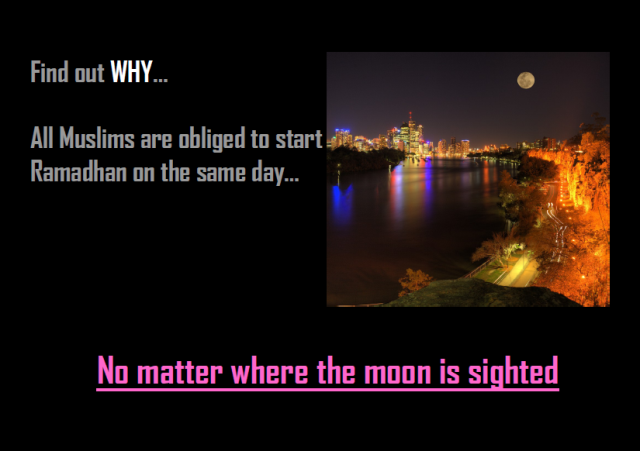
BOOK: All Muslims are obliged to start Ramadhan on the same day


PrintPDF
Download the book from here.
A visual book addressing the topic of why ALL Muslims are obliged to start Ramadhan on the same day no matter where the moon is sighted.
Khilafah.com

Jul 14, 2011

By abducting the shebaab of Hizb ut-Tahrir, Pakistan's traitor rulers only bring the establishment of the Khilafah even closer


Today, 12 July 2011, in the morning, Pakistan's traitor rulers arranged for the abduction of Imran Yusufzai, the Deputy Spokesman of Hizb ut-Tahrir in Pakistan. Like cheap thieves, the government henchmen lurked outside the house of a respected television journalist and captured Imran as he arrived. This cowardly abduction comes within weeks of the abduction of Engineer Aftab, member of Hizb ut-Tahrir, from the sanctity of his Multan home, from a household of two small infant daughters and his cancer patient father. His whereabouts remain unknown. And these despicable deeds come after years of abducting, torturing and threatening the shebaab of Hizb ut-Tahrir in Pakistan in which Pakistan's traitor rulers exceeded all limits, arresting women with small infants in their arms, abducting elderly fathers, threatening the employees until they fired the shebaab from their jobs, threatening the guarantors of bail for the shebaab and torturing until the bones of the spine became separated.

O Muslims of Pakistan!

These desperate acts are a sign of the weak stance of the traitor rulers and expose their weakness further. They come after an intense political campaign from Hizb ut-Tahrir which shattered the ribs of the traitors, stripped them of all reverence in the eyes of the Muslims and incited the sincere in the armed forces to seize them by the throats and punish them at the hands of the Ummah as they deserve. Without a single word of truth in defense of their treason against the Ummah, the country and the armed forces, they have resorted to persecute those whose only crime is to call to their Lord سبحانه وتعالى.

O Muslims of Pakistan!

These desperate acts are a sign of treachery of the faltering rulers and make their treachery more obvious. Like all other actions of the agent rulers, they are carried out with approval from their masters, the Americans, who order them and forbid them, down to the last man, the last meeting, the last policy and the last dollar. The recent escalation against Hizb ut-Tahrir comes after the US Chairman of Joint Chiefs of Staff, Admiral Mike Mullen, visited Pakistan after the nationwide rallies of the Hizb ut-Tahrir in April against the American presence in Pakistan and the attack on Abbotobad by the American forces.

O Muslims of Pakistan!

These desperate acts only increase the resolve of the believers in their efforts and in their belief in the promise of Allah سبحانه وتعالى Who is the sole Master of His Affairs. The shebaab of Hizb ut-Tahrir will stand as they have stood for decades in front of the tyrant rulers throughout the Muslim Lands, they will call to their Lord سبحانه وتعالى, Al-Hay, Al-Qayyum, Ar-Razaaq, in patience and steadfastness and prayer, not fearing anyone but Allah سبحانه وتعالى until Allah سبحانه وتعالى decides His Matter.

رَبِّ انصُرْنِي عَلَى الْقَوْمِ الْمُفْسِدِينَ

"My Lord! Give me victory over the people who are corrupt." [Surah Al-Ankaboot 29:30]

O sincere officers within Pakistan's armed forces! The shebaab of Hizb ut-Tahrir are fulfilling their pledge before Allah سبحانه وتعالى. It is time now for you to fulfill yours. It is time now, O brothers, to grant Hizb ut-Tahrir the Nussrah for the re-establishment of the Khilafah, healing the hearts of the believers and granting them victory over the oppressors.

وَسَيَعْلَمُ الَّذِينَ ظَلَمُوا أَيَّ مُنقَلَبٍ يَنقَلِبُونَ

"And soon will the oppressors know what change in circumstance their affairs will take" [Surah Al-Sha'raa 26:227]

Hizb ut-Tahrir Wilayah Pakistan

12 July 2011 / 11 Sha'ban 1432 AH

khilafah.com

Jul 10, 2011

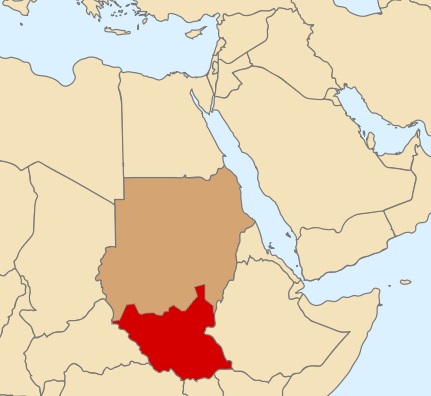
The Colonial Push to Separate Southern Sudan

BURHAN HANIF


In September 2010, at a Sudan meeting on the sidelines of the meeting of the UN General Assembly President Obama said gave an ultimatum to the people of Sudan. "What happens in Sudan in the days ahead may decide whether a people who have endured too much war move forward towards peace or slip backwards into bloodshed." He spoke in reference to the planned referendum for the independence of southern Sudan scheduled for 9th January 2011.

Washington would normalize relations should the Jan. 9 referendum be carried off calmly. He made the promise that if the government of Omar Bashir fulfills its obligations in settling the conflicts, then the United States will support agricultural development, expand trade and investment, exchange ambassadors and eventually lift sanctions. Failure to do so, would lead to a hardening of attitudes.

The drive for the division of the Sudan is not new - though it has accelerated dramatically in recent times. What is called the problem of ‘south Sudan' started after the British occupation in late 19th Century. The British High commissioner in Cairo, Lord Cromer, presented plans in 1883. The British encouraged the Masaleet tribe in 1916, to self-determination. A similar declaration was made by US President Woodrow Wilson in 1918 and again by James Robertson the administrative secretary of the British Government in Sudan in 1946. It is the same as the so-called manifesto of the SPLA rebel movement in 1983. Presently, America is spearheading the effort to enforce this long-planned division, with the support of the current regime under President Omar Al-Bashir.

When Bashir became President, the government abandoned its previous uncompromising refusal to grant self-determination to the people of the south, after the IGAD declaration in 1994. After this, the main steps towards division over 15 years can be summarised as follows:

- 1995 - Acceptance by the so-called opposition forces in the Asmara conference ‘'of the fate determining issues'' of the right to self-determination (i.e. separation) of south Sudan.

- 1997 - The Khartoum peace agreement signed between the current Government and some rebel factions, which stated the right of self-determination.

- 1997 - The Government signed the declaration of the principles of the IGAD stating the right of separation for the south.

- 2005 - Codification of the interim Sudanese constitution for the right of the separation of the south.

- 2005 and 2007 - The Government signed the Mishacos protocol and later the Nifasha agreement which stated the right for separation of the south.

- 2009 - The Juba declaration signed by the SPLA and opposition, which secured the right of self-determination.

- 2010 - Elections scheduled for January 2011 in order to provide democratic ‘legitimacy' needed for the separation of the south.


Is separation a solution to the conflict?

Some have argued separation of the south is the only solution. Scott Gration, Obama's special envoy to Sudan said on 26/4/2010: ‘'We know that the elections are fake and faced many difficulties, but we will acknowledge it in order to reach the independence of the south of Sudan and avoid going back to war''.

President Bashir argued as long ago as the 1990's, on Al-Jazeera TV, that he preferred peace with the separation of the south over unity with war; and that separation would achieve stability.

But the idea of separation as a solution to the problem is simply running away from the real solution to the problems of neglect towards the people of the south. By following colonial powers successive leaders from north and south have neglected the people of the Sudan. Just as the government neglected the people, the rebel movements neglected the people they were supposedly fighting for. None of the people - north or south had their rights and affairs looked after by Islam and its justice.

Far from being a solution separation adds to complexity of problems.

Moreover a dangerous nationalism and tribalism has emerged in the north, calling for a separate south - even saying that the people of the south do not ‘resemble us' and other similar base and ignorant remarks.

The Real Dangers of Separation

The idea of separation has always been brought by colonialists under the guise of ‘independence' for an occupied power.

But separation will not stop the warring. It may precipitate endless wars over territory, between tribes and over the strategic Nile basin.

Land Disputes:

Some have described this area as set to become the Kashmir of Africa, as division provokes irresolvable territorial disputes. To illustrate this, it is worth looking at one or two problems that are well known.

The shepherd herding tribes in west Sudan own half of Sudan's cattle (estimated 15 million according to 1994/95 statistics). The natural grazing and watering areas for them is the middle of the south: the area of Bahr al Gazal, Bahr al Lol and Bahr al Arab. Separation would mean that these tribes would be restricted to the borders of Bahr Al Arab only, which would last them for about only one month. Hence, the potential conflict provoked would be one of survival for these tribes.

Another dilemma is in the Abyei region inhabited by the Denka tribe (who want it to be part of the south). Their claim is disputed by the Maseeriyah tribe who believe that the Denka are living in their area and have refused to accept the outcome of the Nifasha treaty. These kinds of disputes can be avoided when the tribes live under a common authority, but are incendiary when separation occurs.

Strategic Dangers:

What is taking place in Sudan, whether in Darfur region or the south, cannot be isolated from wider politics of the Middle East. In particular the United States would seek to dominate the south and north of Sudan - leading to enormous regional influence affecting both Sudan and Egypt due to influence over the Nile basin.

Moreover, Israel has sought its own strategic influence in the region. There is a historical relationship between the rebel movement SPLA in the south and the state of Israel as party of a wider alliance of countries encircling the Arab world. Israel has interfered in the south of Sudan and established close ties with the rebel movement whether by providing training or by sending experts or reinforcing with heavy machinery. During the time of Former Ethiopian President Mengistu in most of the treaties that were signed between Ethiopia and Israel, Ethiopia had to give a fraction of the arms sent to it by Israel to the SPLA in the south of Sudan. Furthermore Israel used to provide satellite picture to the rebel movement. John Garang (then the leader of SPLA) signed a treaty with Israel that includes the reinforcement of his army with many Israeli military experts. In 1990 more than 15 Israeli experts arrived in the south.

The south of Sudan is an oil rich area. China has interests in this region, and whoever controls this area, controls resources vital to manufacturing economies across the world.

Influence in the south of Sudan means influence over the Nile basin

Influence in the south means influence over the Nile basin and so directly threaten Egypt's and Sudan's security

It has been reported that the United States and Israel and have pressured Egypt to accept one of the following two options: Either to accept providing Israel with what is sufficient for it from the Nile water or to build huge dams in Ethiopia [which has a special relationship with Israel] in order to reduce the water falling into Sudan and Egypt to its lowest level.

In the past, Israel had asked Egypt to change the route of the Nile from the Mediterranean Sea to the desert of Al-Naqab (in Israel). Egypt's foreign ministry revealed in October 2009 that Israel accepted to fund five dams to store water in Tanzania and Rwanda, Tanzania had four dams and one in Rwanda. The agreement by Israel came after the visits by its ‘foreign minister' Lieberman to three of the Nile Basin countries in September 2009.

The establishment of a new state in the south of Sudan would be an ideal time to review the allotment of Nile water - since there would be a new country and its share would have to be defined.

On 31/5/2010 news agencies that the Egyptian water expert, Ahmed Mughawri said that Washington and Tel Aviv want to drag Egypt and Sudan into an eternal war over the Nile water.

The implementation of the Nifasha Treaty has shown without doubt the laxity of security in the south for tribal minorities. There have been individual and collective tribal massacres. The Al Sahafa newspaper [issue 6035 on 30/4/2010] that minorities such as the Moorly, Anwak, Dedenga and Barya in the south and west are endangered, because they are attacked by the biggest tribe of the south, the Deenka, who do so either to control the lands of the minority or as revenge for theft of their herds.

The Deenka are also poor as they have small representation in the government of the region.

Setting the precedent for self-determination

After the south of Sudan, the events in Darfur are the next on the table. Voices of rebel leaders rose there asking for right of self-determination and a settlement upon the lines of the Nifasha settlement.

A meeting held by SPLA in Al Kurmuk city in February 2010 has recommended the self-autonomy or co-federal rule to the Blue Nile province.

According to Akhir Lahza newspaper, sources revealed that a meeting took place between SPLA, Darfur military movements, and officials of French, Israel, American, and Uganda in early January 2010.

The fall of Sudan - through the separation of south first - and then a cycle of division would be devastating for this Ummah.

The Hukum Shar'i on separation:

Islam views separation as forbidden.


Dividing Muslim countries is one of the gravest crimes, to have more than one authority is forbidden, as there must be one ruler for Muslim countries (however large the area).

On authority of Abi Sa'eed Al Khudri said, that the messenger of Allah صلى الله عليه وسلم said: "If pledge of allegiance is given to two Khalifahs, then kill the latter''.

On authority of Arfaja he said: I heard the messenger of Allah صلى الله عليه وسلم say: "Whoever come to you while you are united by one man (ruler) and he wants to divide you, then kill him"

Sudan was unified successfully for centuries under Islam

Sudan is an Islamic land, and was under Islamic authority for long years prior to and after the British colonialism. The land of the south Sudan including its three provinces was opened by Muslims and was under the Sultan of Islam in the time of Uthmani Khilafah and after that under the Mahdiya. Many Historians have documented the historical order of the south of Sudan under the Sultan of the Muslims. Dr.Muhammad Sa'eed Al Qadal in his book ‘The History of modern Sudan' includes a map showing the borders of Sudan during the Egyptian state. That map shows parts of Uganda were considered part of Sudan - up to Lake Albert.

Dr Yusuf Fadl Hasn mentioned in his book: "Studies in History of Sudan and Africa and Arab countries" [Volume 2 1989 the first print on p.81 and 82] "The southern part of Sudan faced dangerous threats from some European states. The state had weak control over that region from Congo, and Belgium was heading towards directorates of Bahr al Ghazal and A'ali Al Neel. In 1884 they fought with the leader Arabi Dafa'Allah and as a result of a French Belgium treaty. A French campaign started by the leadership of Captain Marshand and it was heading to Bahr Al Ghazal and A'ali Al Neel, while the British controlled Uganda and were watchful over the Mahdiya state from the south."

Conclusions

Separation of the south would be haram, and a political disaster. It would be a recipe for endless conflict and subjugation.

No referendum could legitimise such an action - not even under what is called the right of self-determination, because it is giving what you don't own to someone who does not deserve it.

Rather Muslims must work to unify the whole Ummah under the Islamic Khilafah and so end the era of colonialism, instability, internal conflict and subjugation.


khilafah.com

Jul 6, 2011

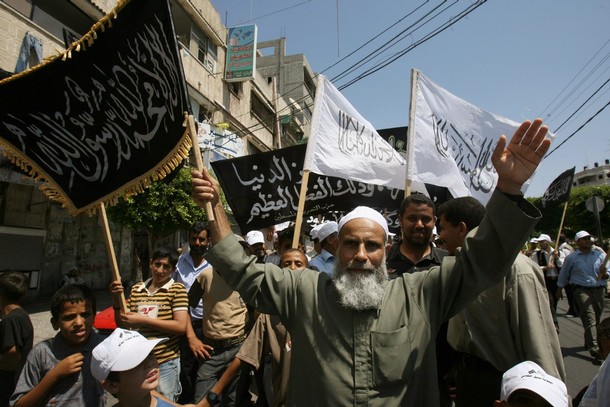
Palestinian Authority Violently Clashes with the West Bank Rallies Marking the 90th Anniversary of the Destruction of the Khilafah

MANAL BADER


All throughout the major cities in Palestine, scheduled rallies were to proudly take place on 2nd July 2011. Ramallah, Nablus, Hebron, Tul Karim, Jenine, Qalqilya and Bethlehem had timed rallies after Asr prayer most departing from the mosques. Hizb ut-Tahrir marked the devastating ninetieth anniversary of the destruction of the Islamic State at the hands of the greatest criminal in Muslim history, Mustafa Kemal Attaturk. The rallies aligned with the Arab states protests calling for the uprooting of the current agent-regimes and erecting a Khilafah state that unites the many statelets under the banner of Islam. Calling upon the Ummah to instigate a genuine revolution not a mere shuffle of agent-rulers. A radical change that yanks the roots of secularism and capitalism out of Muslim lands replacing it with a new seed, Islam. Islam the complete just system from Allah swt to all of humanity.

However true to their nature, the Palestinian Authority Security Forces and Police were present in causing great harm and confusion to participants and onlookers. In attempts to stop the rally in Nablus, the PA forces, dressed in civilian clothing, fired live bullets near the protesters' feet causing several injuries. Several HT members were detained during the rally. Yet the more severe violence took place in Hebron, the PA Forces were more prominent in presence; injuries and arrests numbered in the hundreds. Live bullets and tear gas were fired onto the people. They beat the demonstrating people with clubs and bases of rifles causing massive injuries. More than forty ambulances were unable to accommodate the wounded. In Ramallah, the originally planned central rally, the PA formed checkpoints and blockades around the major city checking ID's and destination points.

Hundreds of Hizb ut-Tahrir members and supporters were forcefully and illegally detained and severely injured, causing several Human Rights Organizations to open case reports and investigations in to the PA's criminal actions against the peaceful protesters all throughout the West Bank.

The PA has once again brought attention to the sincere actions of Hizb ut-Tahrir more than they would have desired. After Hizb ut-Tahrir successfully notified the proper authorities of the scheduled rally, the Ramallah city council approved the rally. Banners, fliers, and radio promotions announced the scheduled rally. Two days before the rally, the PA authorities tore down banners and fliers from the cities. They contacted HT's Palestine media member Baher Saleh alerting him of the ban. Yet the supporters bravely carried on with the scheduled rallies that included speeches to the masses. Following with conviction and courage in the footsteps of the Prophet Muhammad صلى الله عليه وسلم, members and supporters of HT carried out the flags (rayat) of the Ummah and their voices chanted over the gun fire. The day after the rallies, the PA's Police media spokesman stated, Yousef Uzrain stated the rally was banned due to political reasons with them being unknown.

Indeed calling for the eradication of the agent-regimes that support and protect the Israeli presence has caused a great discord to the Palestinian Authority. Alhamdulillah, Muslims are no longer afraid of the silence that brought ninety years of misery and oppression. They want and seek a true solution. Islam will revive the Ummah to the highest levels and break the chains of Western servitude and darkness. Inshallah the end is near for the agent-rulers as we are witnessing today and the beginning of a new era is near for the millions of Muslims world-wide.

وَسَيَعْلَمُ الَّذِينَ ظَلَمُوا أَيَّ مُنْقَلَبٍ يَنْقَلِبُونَ

"Those who do wrong will soon know the kind of reversal they will receive!" [Ash-Shu'araa, 26:227]

Manal Bader

Bayt Al-Maqdes

3rd of July 2011

khilafah.com

Jul 4, 2011

O liberated people of the world! Look at the oppression of the regime in Uzbekistan

بسم الله الرحمن الرحيم

O liberated people of the world! Look at the oppression of the regime in Uzbekistan

We direct this address firstly to the Muslims of the world, for this oppression falls on a people only because they carry the Islamic call, and we direct it secondly to all human rights organizations, and thirdly to all liberated people in the world. What we mention here are just some examples that happened over the last month, though they were preceded by many atrocities from this regime, that we have mentioned previously.

1 – The Shaab, Ooulmasaw Bahadir, of the city Margalan was detained in a Garawol Bazaar prison in Bukhara province. The supervising police officers in the prison tortured him worse than beasts in a jungle. He nearly bled to death yet they did not take him to hospital and instead transferred him to another prison.

2 - The Shaab, Rosebayev Hakeem Jan, of the Andijan province, has been in Jasliq prison since 1999. He was due to come out of prison in the month of March this year because he finished his sentence, but the prison administration extended his detention for five more years, for no other reason than to keep him in prison. They transferred him to a prison in Zarafshan town.

3 – The Shaab, Mrzaiev Abdul Aziz, from the Tashkent province, Chinaz district, was sentenced to twenty years and he was in the 64/51 prison in the town of Kasane, Qashkadiria province. On 7 June, the current management of this prison brought his body to his family and ordered them to bury the body quickly, without showing the body to the people. When his family tried to wash his body and put him in the coffin, the witnesses saw traces of torture on the body. They saw that his skull was fractured, his eyes were out of their sockets, his neck stitched up to the back of his head and his chest stitched from his navel to his chin. The governor of the prison responsible for this torture is Colonel Rakhmonov Erkin Mustafa Aowith.

4 – The state of Uzbekistan tightened pressure not only upon prisoners who are in prison, but also upon their relatives who are outside of jail as well as upon the relatives of those whom they want to arrest but did not find them or they fled from their homes, some fleeing to other countries and others fleeing to became homeless within the country. The intelligence chases their relatives and asks them to present themselves to police stations for interrogation, threatening them on one hand and trying to entice them to serve their interests, by becoming spies for the state, on the other hand.

Some of these intelligence officials acknowledge that they are commanded to perpetrate these acts upon the orders of the highest leadership in the state, i.e. the head of state, Karimov.

These are some examples of oppression from Karimov against the Shebaab of Hizb ut-Tahrir in particular and there are other examples against all those who call for Islam, even those who are not from Hizb ut-Tahrir. This is because he fears that Hizb ut-Tahrir may incite the thoughts and feelings of the Ummah in this country to overthrow him from power because of his tyranny and his Kufr. But his tyranny will hasten his fall, for we see now what is happening in the Arab countries, where people erupted due to the severity of the oppression of the tyrants. The peoples of Central Asia are not far from eruption in the faces of their tyrant rulers, and in particular the ruler of Uzbekistan.

وَكَذَلِكَ أَخْذُ رَبِّكَ إِذَا أَخَذَ الْقُرَى وَهِيَ ظَالِمَةٌ إِنَّ أَخْذَهُ أَلِيمٌ شَدِيدٌ

"Such is the chastisement of your Lord when He chastises communities in the midst of their wrong: grievous, indeed, and severe is His chastisement." [Hud, 102]

Hizb ut-Tahrir Uzbekistan

25/6/2011 / 23 Rajab 1432 AH

sources khilafah.com

Jul 2, 2011

28th Rajab the day when the Ummah lost its shield

بِسْمِ اللّهِ الرَّحْمَنِ الرَّحِيمِ

Media Office of Hizb ut-Tahrir in Afghanistan
Press Release
Date: 27 Rajab 1432 / 2011/06/29
No: Afg. 1432/8

28th Rajab the day when the Ummah lost its shield

On 30th June, 2011 (28th Rajab) the Muslims Ummah will complete the 90th (Hijri qamari) year of living without Khilafah. Indeed the abolition of the Khilafah followed years of decay, and decades of decline - the final act in a much longer process where Muslims stopped referring to their Deen to solve life's affairs, instead becoming infatuated with Western secular ideas.

The Khilafah had been a great state for centuries. It was a superpower on the world stage. It was a leading state in science, technology, commerce, architecture and jurisprudence. The Khilafah provided peace and security for the Muslims, allowing them to live in harmony together as a single state, regardless of their language or race. The Khilafah even provided sanctuary for those who were persecuted because of their beliefs. Its armies defended Muslims when they were attacked and carried the Deen of Islam to world. For hundreds of years of Islamic rule, before the British occupation, the Indian Subcontinent flourished in a manner unrivalled before or since by any non-Islamic rule.

After the eventual destruction of the Khilafah State the Western colonial powers installed puppet rulers in our countries who would continue to serve the interests of the Western powers, rather than obey Allah and His Messenger, and serve the Muslim Ummah. Decades later, it is little wonder that crooks and gangsters who usurp power such as Karzai, Zardari, Mubarak, Gaddafi, the house of Saud etc have the red carpet laid out for them in Western capitals.

Today, the Western powers who sense the growing call to remove these corrupt rulers and re-establish the Islamic Khilafah state are desperately trying to prevent this by occupying our lands and spreading malicious propaganda against the call for Khilafah. Only recently the retired UK army chief, Richard Dannat when asked about the occupation of Afghanistan, said; "there is an Islamist agenda which if we don't oppose it and face it off in Southern Afghanistan, or Afghanistan, or in South Asia, then frankly that influence will grow. It could well grow, and this is an important point, we could see it moving from South Asia to the Middle East to North Africa, and to the high water mark of the Islamic Caliphate in the 14th, 15th century."

This Rajab, Hizb ut-Tahrir is holding landmark conference in different parts of the world, where hundreds of thousands of people will participate. These conferences will bring Muslims from all over the world, including politicians, journalists, thinkers, academics and other influential people to call for the historic return of the Islamic Khilafah State. The conferences will aim to raise the issue of establishing the Khilafah State to the top of the agenda in the Muslim world.

Re-establishing the Khilafah is not an issue amongst issues. It is THE most vital issue for the Muslim Ummah. Every day our blood is spilt cheaply in Palestine, Afghanistan, Pakistan, Kashmir and Iraq. The Muslim Ummah is crying out for a leader who will take a stand against these brutal occupations and stand up to the oppressors. To re-establish the Khilafah we need to build an overwhelmingly strong movement within our countries that will overthrow the corrupt rulers from their thrones and bring into place a Khalifah who will implement the Shariah and stand up for the affairs of the Muslim Ummah.

Join us in building this global movement.

The Prophet (sallallahu alaihi wasallam) said "A single day under a just ruler is better than 60 years of ibadah" [Bayhaqi / Tabarani]

Jun 30, 2011

Between Sufism and Salafism

Unfortunately today we find groupings amongst the Ummah who have taken the age old divisions regarding the branches of belief, usūl al-fiqh and jurisprudence to extremes. They speak with an agenda to refute each other and exhaust much effort in this pursuit. Regrettably they consider each other the enemy whilst our lands are occupied by the kuffār, such as the land of the Isrā’ and Mi’rāj (The Prophet’s Night Journey), whilst Muslim blood is spilt by the colonialists the world over and whilst the enemies of Islam seek to seduce Muslims away from our core values, sharī’ah rules and even our ‘aqīdah (belief).

Putting aside the fringe minority amongst both camps, who have clearly gone totally astray – such as those amongst the Sufis that believe in Wahdat al-wujūd – that Allāh (swt) is part of the creation, or those amongst the Salafī ultra-Żāhirī’s (literalists) who make Takfīr (pronouncing disbelief) on everyone apart from themselves – looking at the mainstream of both camps today, one can notice that both sides have gone beyond the bounds of what their founders, and the classical scholars that they refer to, taught.

The Ash’arī scholars and pioneers in history, whilst they disagreed strongly with the views of the literalists did not consider them and their scholars as enemies. They did not consider Ibn Taymiyyah, Ibn al-Qayyim, Ibn Kathīr and the like as heretics even though they differed with them in many issues, ranging from the definition of Imān, the manner in which to understand the sifāt(attributes) of Allāh (swt), in the usage of Qiyās (legal analogical reasoning) and the permissibility of Taqlīd (following qualified legal opinions of a mujtahid) to a school of thought (madhhab). In fact they did not even consider this camp in the same light as the heretical groups such as the Mu’tazilah or the Khawārij. On the contrary the books of these scholars were respected and quoted by Ash’arī scholars throughout history. It is true that they strongly criticised the literalist camp for their approach and views but this was on the scholarly intellectual level and must be taken in this context. This was the practice even amongst the Salaf as-Salihīn (pious predecessors), such as the founding fathers of the madhāhib (schools of thought). For example when Imam al-Shāfi’ī criticised the principle of Istihsān (juristic preference), a secondary source of law utilised by the Hanafī school, in the chapter Ibtāl al- Istihsān (Refutation of Juristic Preference) in his book Kitab al-Umm, he equated the one who adopted it similar to the one who makes the mind sovereign. This in no way meant that he viewed them as deviants; on the contrary he respected his teacher, the student of Imām Abū Hanīfah, Muhammad ibn al-Hasan al-Shaybānī with high regard.

Similarly the literalist scholars whom the Salafī camp hold in high regard and take their thought from; whilst they also harshly criticised the Ash’arī’s, especially on some of their views such as the attributes of Allāh (swt), their definition of the Qur’ān as an expression of the speech of Allāh, their definition of Imān (belief) as being Tasdīq (assent) in the heart and not including actions, and their justification of Taqlīd – they did not consider them as heretics or deviants deserving the wrath of Allāh (swt). Look at what Ibn Taymiyyah himself says:

“It is not necessarily the case that everyone who makes a mistake in matters of ‘aqīdah is destined to be from the destroyed and the losers. Perhaps, the disputant was a mistaken mujtahid for whom Allāh will forgive his mistake. It is also possible that he did not receive enough information about the topic to conclude that the proof has been established against him.” [Ibn Taymiyyah, Majmū’ al-Fatāwa, vol. 3 p.179]

In fact he mentions that even the Salaf differed on various issues; even those related to the belief. He says:

“The early pious people (al-salaf) disputed about many of those issues. Yet none of them declared the others of having unbelief, evil or sin. Shurayh rejected the reading of the verse, “But I wonder (‘ajibtu) while they mock” (al-Sāffāt: 12). He said, “Allāh does not wonder.”[1] When that reached Ibrāhīm al-Nakha’ī, he said, “Shurayh was a poet who was overcome by his own knowledge. But ‘Abdullah [ibn Mas’ūd] was more knowledgeable than him and he would read, “I wonder”. And ’Āishah disputed with the other Companions regarding Muhammad (saw) seeing his Lord. She said, “Whoever claims that Muhammad saw his Lord has committed a great falsehood against Allāh.” Despite this, we do not say about Ibn ‘Abbās or others who disputed with her on that point, that they stated a great lie against Allāh. They also disputed about whether the dead could hear the words of the living, whether the dead is punished for the crying of his family and so forth…” [Ibn Taymiyyah, Majmū’ al-Fatāwa, vol 3, pp. 239-240]

Remember they considered that Allāh (swt) would forgive the sincere believers for their mistakes even in matters they believed were clear, as is mentioned in the hadīth, “Allāh has pardoned for my nation [what is done] by mistake, out of forgetfulness or under duress.”

If we were to look at the reasons why Abul Hasan al-Ash’ari (d. 936 CE) and those who followed him as well as scholars on the literalist side like Ibn Taymiyyah (d. 1328 CE) entered into the debates about the branches of belief we would find that they did so with the noble purpose of defending the Islamic creed. Imam Abul Hasan al-Ash’ari rose to the challenge of refuting the strange views of the deviant group, the Mu’tazila who were creating confusion in his time. Sheikh ul Islam Ibn Taymiyyah on the other hand faced the incorrect views of the extreme sufi mystics influenced by foreign philosophies head on and exposed them.

It would be much more productive, in line with the obligation of enjoining the good and forbidding the munkar (evil) and in keeping with the ethos of the classical scholars, for both camps today to focus on refuting the intellectual onslaught launched by the Kuffār upon the Dīn, its definitive concepts, rules and even the Islamic creed. Today, in the name of reformation people are questioning thehudūd laws set by Allah; they are attempting to destroy the Islamic concept of brotherhood by permitting the alliance with the kuffār against the believers; they attempt to cast doubt on the obligation of the khimār (headscarf) and jilbāb upon the woman in the public life and want us to turn away from the fundamental aqeeda concept of the sovereignty of Allāh (swt) by accepting man-made laws. Secular liberalism championed by the west is the real threat that is corrupting millions of Muslims worldwide not the centuries old debates on the branches of aqeeda and usul al fiqh. One may point to modern day Sūfīs or Salafīs who are modernists used in this campaign against the normative concepts in Islam in order to strengthen his argument against the other camp.

However, it is clear that there are some in both camps who are being used to cast doubt on the fundamentals of the Dīn. There are some who claim to be the followers of Abul Hasan al-Ash’arī yet they go against the qat’ī (definitive) matters, contradicting what is established by evidences that are definitive in authenticity and meaning. They going against the consensus of all the scholars including the four Imāms of the madhāhib and all the scholars from amongst the Ash’arī’s such as Qādī ‘Iyād, Al-Ghazālī, Imām al-Haramayn al-Juwaynī, Al-Suyūtī, Al-Rāzī, Al-Nawawī, Ibn Hajr al-Haytamī, Ibn Hajr al-‘Asqalānī and others.

They argue away the hudud (prescribed punishments) of Allah such as the obligation to cut the hand of the thief and lashing the unmarried fornicator on the pretext of the changing of the time and place. They misuse the principles of masalih al mursala (public interests), dharoora (necessity),alhaf al-dararain (the lesser of the two harms) and the like to justify the taking of riba (usury), electing people to rule by other than Islam and other matters that would be considered blasphemous to the Ash’ari scholars of the past.

The modernist scholars error is not due to being Ash’arī; rather it is due to being those who are justifying the unjustifiable and their thoughts need to be exposed by both Ash’arī and non-Ash’arī ulema alike.

Similarly it could be said that there are Salafī scholars that legitimise the clearly non-Islamic rule of the Kingdom of Saudi Arabia and justify the Kingdom’s actions such as its alliance with America. Again those who do this are manifestly turning away from the path of the Salaf, the definitive evidences and the consensus of all scholars including Ibn Taymiyyah and Ibn Kathīr. The literalists scholars did not only view it is as a strong prohibition; they in fact considered ruling by other than what Allāh (swt) has revealed as disbelief.

Ibn Taymiyyah said: “Undoubtedly, whoever does not believe that it is obligatory to rule according to that which Allah has revealed to His Messenger is a Kafir (disbeliever), and whoever thinks it is permissible to rule among people according to his own opinions, turning away and not following which Allah has revealed is also a Kafir…So in matters which are common to the Ummah as a whole, it is not permissible to rule or judge according to anything except the Quran and Sunnah. No one has the right to make the people follow the words of a scholar or ameer, shaykh or king. Whoever believes that he can judge between people according to any such thing, and does not judge between them according to the Quran and Sunnah is a Kafir.” [Ibn Taymiyyah, Minhaj as-Sunnah, 5/130-132]

Hence, the Salafi-modernists should be exposed by the Salafī and non-Salafī scholars alike.

Perhaps it is also time for both camps to go back to the original sources of the Qur’ān and Sunnah, which are the sources of guidance for the Ash’arīs and Salafīs alike, and attempt to neutrally re-evaluate some of their controversial views. If one was to refer back to the original sources instead of continuing to adhere to the position of their camp, they may conclude that some of the views they have been adhering to are weak or incorrect; such as the traditionalists position that the doors of Ijtihād are closed even though it has been established that Ijtihād is Fard al-Kifāyah (an obligation of sufficiency). Similarly if someone from the Salafī camp independently reconsiders the literalist position of the prohibition of taqlīd he may discover its weakness, as the Qur’ān commands us to,“Ask the people of dhikr (understanding) if you know not” [TMQ 21:7] and the Prophet (saw) said,“The cure for the lack of knowledge is to ask” as well as many other evidences. Maybe if we go back to the original sources and study the matters neutrally, instead of trying to dogmatically defend the position of our teachers and our camp, we may find that the true path is neither Sufism nor Salafism, Ash’arī or Żahirī but that it is a path in between the two.

More importantly regardless of our scholastic or juristic persuasions let us unite against the clear disbelief of secular liberalism and take heed in the words of our Lord,
“And those who disbelieve are allies to one another, (and) if you do not do so, there will be Fitnah (wars, battles, polytheism) and oppression on the earth.” [TMQ Al Anfal: 73]

In this era where the war against Islam is intense and spans the globe it is not fitting for us to exhaust energy in polemics of centuries bygone. Surely refuting the creed of dividing religion from politics and worldly life that has actually affected the ummah en masse is more important than the semantics of the definition of Iman. The thousands of hours spent by imams, speakers, writers and activists in discussing whether the attributes of Allah are literal or metaphoric would be much better spent in actually working to replace the satanic laws that our lands are governed by with the law of the All-mighty, the Supreme. We need to unite upon our fundamentals and despite our differences work together so that the kalima (word) of truth becomes the highest.

“And hold fast, all of you together, to the Rope of Allah and be not divided among yourselves, and remember Allah’s Favour on you, for you were enemies one to another but He joined your hearts together, so that, by His Grace, you became brethren, and you were on the brink of a pit of Fire, and He saved you from it. Thus Allah makes His Ayat clear to you, that you may be guided.” [TMQ Aal Imran: 103]

Abu Ismael

sources from islamicsystem.blogspot.com

Jun 29, 2011

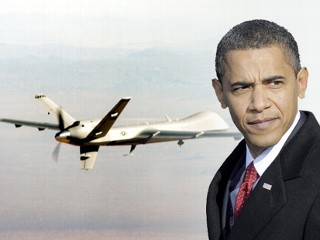
The Obama Doctrine, Pakistan and the "drawdown" from Afghanistan

DR ABDUL-WAHID


Last week US President Barack Obama announced a timetable for withdrawal of 30 000 in Afghanistan.

This has been variously portrayed as defeat or a deliberate move that is part of an overall strategy.

The drawdown is in fact a sign of defeat, but is also part of an overall strategy for the region, much of which goes unsaid, for political reasons. But as such, it exemplifies to the full the Obama doctrine in foreign policy.

This doctrine has three key characteristics. These three qualities have characterised this presidency and are, in part, why some of those who lauded his arrival in the White House are more than a little disappointed.


Firstly, the unashamed pursuit of American interests around the world, as hegemonic as any of his predecessors. Those who had hope in Obama expected something less destructive and unjust than the ruthless pursuit of American interest – so, the escalation of the 'war on terror' in Pakistan and Yemen, including the use of extrajudicial assassinations, has shattered their illusions.

Secondly, which distinguishes him from his immediate predecessor, is that he has a far greater awareness of America's strengths and weakness and hence its capacity to act around the world. Many of his supporters around the world had hoped for a substantial change of policy in the Muslim world, not merely a change in tone and tactics brought about by two military defeats, an economic collapse and the obstacle of anti-American public opinion.

Thirdly, is this regime's exceptional ability to spin the situation in order to make the best political capital. People in their naïve optimism did not expect that serious decisions on war and peace would be made so cynically, according to the timetable of a presidential election.

Spinning a bad situation

What the White House under Obama lacks in terms of principle, it has surely made up for in terms of the ability to portray a false image and exploit matters for political ends.

Whether Obama's Cairo speech that promised so much, and delivered so little; or much vaunted the promise to close Guantanamo Bay that has gone unfulfilled till today; or whether it is the statement that America is with the people in the Arab uprisings, made after support for Hosni Mubarak till the eleventh hour, and support for Syria's Assad and Bahrain's royal family well beyond that. All of these illustrate a massive gap between rhetoric and substance.

When Obama announced a drawdown of 30 000 troops from Afghanistan, somehow the message came across that the US was withdrawing. It is not. It will still retain 68 000 troops in the region. It is merely withdrawing those used in the 'surge'. However, the timing of the withdrawal coincides very favourably with next year's presidential debates. It plays very well with American voters, which most polls suggest significant numbers favour withdrawal of US troop – ranging from 54% [The New York Times / CBS News poll was conducted Feb 2011] to 72% [USA Today / Gallup Jan 2011].

Yet, despite this talk of a 'position of strength' America has undoubtedly seen a humiliating defeat in Afghanistan.

Veteran journalist Bob Woodward exposed the admission of defeat, and the subsequent need for an exit strategy in his book 'Obama Wars'. "This needs to be a plan about how we're going to hand it off and get out of Afghanistan" Obama is quoted as telling White House aides as he laid out his reasons for adding the 30,000 troops in the first place. "Everything we're doing has to be focused on how we're going to get to the point where we can reduce our footprint. It's in our national security interest. There cannot be any wiggle room."

Woodward quotes Obama as saying "I can't lose the whole Democratic Party".

US analyst George Friedman wrote in June 2011 "The conventional definition of victory has been the creation of a strong government in Kabul controlling an army and police force able to protect the regime and ultimately impose its will throughout Afghanistan." By this definition, they are nowhere close.

Those who remember the objectives before 'mission creep' started in the Bush era, to disrupt Al Qaeda's ability to strike at the USA [an absurd idea when one looks at the US's own analysis of how 9/11 happened, never mind what others thing], can look to Obama's publicly stated goal that America looks to Kabul running the country and looking after its own security.

This is simply not likely to happen in a way that the administration would have people believe. Karzai is not a master outside his own neighbourhood, and the 'Afghanisation' of security is expecting a very basic security force to master what the NATO and ISAF could not.

The administration that has decided on this exit for political reasons has tried hard to put a face-saving spin on the situation. But military leaders in America and Britain, who cried that the 'job' had not been done and that victory had not been achieved – but could be, if only they were given the chance and resources – took a shine off this gloss.

Changing tactics to fit the resources

One thing the Obama administration has been swifter than the US military to appraise honestly is America's current strengths and weaknesses; and the likelihood of creating a stable, secure and prosperous Afghanistan.

There is no getting away from the fact that the United States was humiliated in Iraq and Afghanistan. Even if the military leadership were right [and that is a very big 'if'], it is almost certainly unaffordable politically and financially.

America has still not recovered from the financial crisis of 2008. It has a budget deficit of $1.6 trillion. Credit rating agencies have been sounding warnings about the state of the US economy – though by objective measures other, less powerful States, would have already been downgraded by now.

There is still talk of a dollar crisis on the horizon, which would have monumental consequences of the United States.

What America has done is recalibrate its foreign policy goals within a climate of fewer resources. It has amended its tactics accordingly.

In particular its focus has shifted even away from Afghanistan and onto Pakistan. If Pakistan was the base used to launch its mission in Afghanistan, Afghanistan is now the base to do the reverse.

But the mission is not an overtly military one. It is a covert and altogether more sinister one. Writing in Foreign Policy this month, Senator John Kerry, of the powerful Foreign Affairs Senate Committee said: 'Now it's time to focus on the real threat in the neighborhood: the one coming from Pakistan'. He said 'as our troops shift from the south to the east, their mission should shift accordingly from counterinsurgency to counterterrorism.'

This will rightly alarm people in Pakistan. As CIA chief Leon Panetta moves to the Pentagon and General Petraeus goes to the CIA, America plans to focus even more on Pakistan. It all suggests that the forces destabilising will increase but in a more covert way, and less obvious to the outsider that the United States is engaged in a war within Pakistan.

The commentator Peter Oborne, who has visited both Pakistan and Afghanistan, wrote in the Daily Telegraph saying 'Incoming defence secretary Leon Panetta's solution, expounded at his Senate confirmation hearing earlier this month – to place US military personnel under CIA direction, so their operations can be made secret and unaccountable – is sinister and unconstitutional.'

This is true. But it is also a less costly way to pursue policy interests in Pakistan; and will be less unpopular with the American voter, who will be even less well informed of its government's actions in the region.

Yet it is not pursuing any fundamentally different strategic objectives than before.

The interests remain unchanged

Afghanistan and Central Asia has long been seen as strategically important for America in controlling World affairs – a matter summarised by Zbigniew Brzezinski, former National Security Advisor and an advisor to Obama in an article he wrote for Foreign Affairs magazine 15 years ago: "Eurasia is home to most of the world's politically assertive and dynamic states. All the historical pretenders to global power originated in Eurasia... A power that dominated Eurasia would exercise decisive influence over two of the World's three most economically productive regions, Western Europe and East Asia...almost automatically control the Middle East and Africa. What happens with the distribution of power on the Eurasian landmass will be of decisive importance to America's global primacy and historical legacy." [A Geo-strategy for Eurasia, Foreign Affairs, September/October 1997]

Others have pointed out that the US geological survey of 2007 confirmed untold mineral and energy resources in the region, making this prize more significant than its geostrategic worth.

Yet geology and geo-strategy are in no way mutually exclusive. Brzezinski highlighted as far back as 1997 that America's future rivals for economic supremacy included China and India who were in this region: 'The world's most populous aspirants to regional hegemony, China and India, are in Eurasia, as are all the potential political or economic challengers to American primacy. After the United States, the next six largest economies and military spenders are there, as are all but one of the world's overt nuclear powers, and all but one of the covert ones.' Back then, he omitted a resurgent Russia, which he would surely have to include as a regional player now, and one capable of making more than a little mischief.

Add to this that the resources which add to the growth potential of manufacturing countries and growing economies lie on their doorstep. Moreover, Pakistan is a crucial piece in this jigsaw in respect of its relationship with India and China. Cooperation with China in the development of the deep-sea port at Gwadar gives China access to the Arabian Sea, saving a fortune on shipping costs.

The United States sees China as a potential rival but one with whom its own trade relations are dependently intertwined. And although the rising economic giant has in no way shown any proportionate signs of political strength, America has long viewed a strong India as a regional buffer to check China's political pretensions. This has been one of the reasons America has put huge pressures on the Pakistani government to mend relations with India – in order to create a more stable environment for India; since India's hostility with Pakistan jeopardises its ability to exploit transport routes for essential energy supplies

Add to this that Pakistan is the only Muslim country with a nuclear defence capability; and that it is a country with growing Islamic sentiments.

A Gallup poll in January 2011 found that a majority of Pakistanis want the government to take steps for the Islamisation of society. The poll found that 67% of Pakistanis want the government to take steps to Islamise society, as compared with 13% responded by saying Pakistan did not need Islamisation (and 20% gave no response).

I will discuss the full significance of this point later – suffice to say, the Islamisation of Pakistan would present America with a series of serious obstacles to its strategy in the region. The likelihood of Pakistan becoming submissive towards a more powerful India would vanish. The use of energy and other resources for its own population – as well as for economic and political strength – would mean a third rival in this most important of regions.

Consequently, for these reasons alone maintaining a strong hold on events in Pakistan is essential for the United States – whether that is by sustaining unpopular governments like those of Musharraf and Zardari; or by making aid ever more conditional on following American policies (for example through the so-called Kerry-Lugar Act); or by putting pressure on the Pakistani military to cooperate in Afghanistan against the wishes of its own population.

Expecting the people of Pakistan to accept unpopular military policies, as well as to change their Islamic sentiments has been destabilising to say the least.

In regards to this last point George Friedman of Stratfor illustrates how serious a dilemma this has been. Describing the tensions that have vexed the Pakistani regime for a decade he writes that back in 2001 'they did as much as they could for the United States without completely destabilizing Pakistan while making it appear that they were being far more cooperative with the Americans and far less cooperative with their public. As in any such strategy, the ISI and Islamabad found themselves engaged in a massive balancing act.'

This balancing act has continued until today. US Drone attacks on Pakistan are condemned by the government, but tolerated; US security operatives (private contractors and CIA) seem to have a free license to operate in Pakistan, but this is denied by the regime (the case of Raymond Davies, who killed two Pakistanis and was exposed as an illegal operative yet escaped prosecution, is not an isolated one); the raid that killed Osama bin Laden violated Pakistan's sovereignty, yet the debate goes on about 'who knew what and when'.

The pressures on governments and leadership of armed forces of Pakistan to cooperate have been enormous: from Colin Powell's alleged threat to bomb Pakistan to the stone age and the hard talk of the late Richard Holbrooke – to the conviction within Pakistan that American black-ops are behind a significant proportion of the bombing of civilian areas in the country attributed to 'terrorism', in order to manufacture an environment where people accept 'more' to be done to deal with 'extremism'. This 'more' has been a mix of de-Islamisation policies, as well as military actions in the FATA region [Federally Administered Tribal Areas].

The idea, commonly held in Pakistan, that this destabilisation is not accidental is not as conspiratorial or paranoid as it seems.

The aforementioned analyst, George Friedman of Stratfor, summarised all of this in his 2009-book 'The next 100 years, a forecast for the 21st Century': "The US has had the ultimate aim of preventing the emergence of any major power in Eurasia. The paradox however is as follows – the goals of these interventions was never to achieve something – whatever the political rhetoric might have said – but to prevent something. The United States wanted to prevent stability in areas where another power might emerge. Its goal was not to stabilize but to destabilize, and this explains how the United States responded to the Islamic earthquake. It wanted to prevent a large, powerful Islamic state from emerging. Rhetoric aside the United States has no overriding interest in peace in Eurasia. The United States also has no interest in winning the war outright...the purpose of these conflicts is simply to block a power or destabilize the region, not to impose order."

This has been the aim of policy under the Obama administration as it was under the Bush administration.

Beyond the liberal world order

All of this could appear extremely bleak for the people of Pakistan. Indeed, if the policies continue thus, unchanged, the future is bleak.

Yet, there is one way out – and it is via the route that every signpost erected by the West and its allies in the region is saying not to go near.

That is the Islamic route.

In his speech in Westminster Hall, Barack Obama acknowledged that emerging economies were fast gaining ground on the United States, and would want more of a say in a world currently dominated by America and Europe. But he made one thing very clear. Even if America is in decline, or if the European project is collapsing, the world order has been made in the image of the West.

The nation state is the accepted model for all countries. The United Nations Security Council decides the law for most of the world [except for its permanent members]. The global capitalist economy is the route by which China, India, Turkey, Russia and Brazil have grown in wealth.

Any new emerging power, however, distant they are from America in terms of a political challenger [which is a very different thing from having economic growth], must develop and grow according to the rules set by America and Europe.

This means that one day, the world looks more to the Lakshmi Mittal's and Oleg Deripaska's, than it does to the Warren Buffet's and Bill Gates's for an example of success. It means Muslim countries can improve their lot – for their wealthy and elites, like India, Russia and China have done – and hope that some trickles down to the ordinary citizens. It means that some states – states that have large populations, growing economies and political muscle – will compete over smaller, divided, failing regions in Asia and Africa.

America sees China as a rival, but not yet a threat. China has the largest growing economy of the world – but it is the largest direct investor in the US and as such is helping to support a weakening US economy. It holds over 2 trillion dollars of foreign exchange, and could theoretically cause the US economy to collapse overnight. But its relationship with America – as one of provider and purchaser, as well as debtor and indebted -means that it would be shooting itself in the foot if it did so.

But if, as is feared a powerful Islamic state emerged, it would offer a system that sits outside this cosy, liberal, capitalist order. That is its real power.

It would offer an economy that was built on real commodities and not virtual currency. It would offer a market in trade, with clear rules so that within that framework free trade could emerge – but would prohibit the speculative and casino markets that have caused so much instability. Islamic law would force it to use energy and material resources for its citizens, clashing with the interests of Western energy giants and others. Moreover, it would work to end a foreign military presence in the region.

It is for these reasons the Islamic system is the one they all want to stop emerging. It has little to do with terrorism, extremism etc. but is about controlling what they can, for their interests.

There are those in America who feel they are fighting for religious reasons. But this is not the reason that Friedman says America wants to 'to prevent a large, powerful Islamic state from emerging'. It is also not the reason that Bush launched the 'war on terror'; and it is not the reason why Obama's focus is on Pakistan.

Strangely enough, viewed from this perspective, it is the people of Pakistan and the Muslim world who have the upper hand, if only they realised it, and seized the opportunity for a real change.

SOURCES FROM KHILAFAH.COM